

Anyone looking to invest in Eastern Europe without the risk of individual stocks has basically two options: taking a broad approach through emerging market ETFs or targeting the region directly with specialized products. These two strategies differ more than their names suggest.
Why Eastern Europe is interesting again
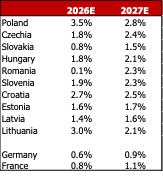
The region continues to deliver above-average growth. For 2026E–2027E, the European Commission expects annual GDP growth across Central and Eastern Europe — especially CE-3, Slovenia, Croatia, and the Baltics — to significantly outpace Germany and France, with Poland leading the pack at 2.8% to 3.5%.
Source: European Commission, East Value Research GmbH
Source: stooq.pl, East Value Research GmbH
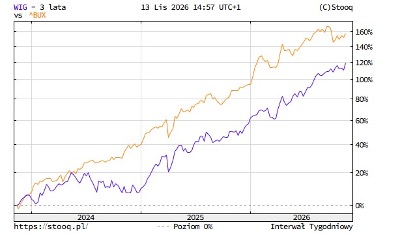
In addition, regional stock markets — especially the most liquid exchanges in Warsaw and Budapest — have delivered exceptional performance over the past three years. Strong indicators suggest this momentum will carry into 2027E, supported by robust growth forecasts and more liberal and investor-friendly policies in Hungary under new Prime Minister Péter Magyar. As a result, the region is now on the radar of many new investors. But is a specialized Eastern European product really the better choice over a classic emerging markets ETF?
Different products, different bets
The MSCI Emerging Markets Index has surprisingly little exposure to Eastern Europe. As of the end of October 2026, Taiwan made up 28.9% of the index and China 20%, followed by South Korea at 19.7% and India at 11.7%. Taiwan Semiconductor Manufacturing Company (TSMC) alone accounted for 15.9%. While Poland, Hungary, and the Czech Republic are included, their combined weight amounted to only 1.5%. Investors buying an ETF on this index are primarily betting on Asia and semiconductors. Meanwhile, Russia has played no role since its removal in spring 2022, shortly after launching its war against Ukraine.
Specialized CEE ETFs such as the Amundi MSCI Eastern Europe ex Russia, by contrast, focus specifically on this region. The underlying index comprises roughly 22 large, liquid companies from Poland, Hungary, and the Czech Republic. Country weightings vary depending on the source and reference date: current figures put Poland at 72.8%, Hungary at 20.2%, and the Czech Republic at 7%.
Alternatives include focused mutual funds e.g. the Trigon New Europe — which often also hold Kazakh, Baltic and Turkish stocks picked by a professional portfolio management team — as well as exchange-traded certificates/structured products such as the Wikifolio “Emerging Europe“, where portfolio holdings are selected by the owner.
Stress test 1: Diversification
Neither of the above-mentioned approaches performs well here, though for different reasons.
- MSCI EM: They are broad at the country level, yet heavily concentrated. A handful of Asian markets and a single technology giant dominate performance. Moreover, because more than USD 2.2tr (thereof USD 300bn passive) of assets track the index, capital flows can amplify price swings.
- CEE ETFs and mutual funds: Banks (which are often the largest and most liquid stocks) dominate, complemented by energy, utilities, and select consumer stocks.
- Wikifolio Structured Products: Can only include companies with a dual-listing in Germany.
Stress test 2: Returns
A look at the numbers explains the current interest in the products. According to onvista.de, the Amundi CEE ETF returned 39.6% over the last 12 months. Over three years, it delivered a total return of 132.5%.
These figures represent a snapshot taken after an unusually strong rally. Caution is warranted for three reasons:
- The valuation expansion in CEE after years of discounts cannot be repeated indefinitely.
- Banks depend heavily on interest rate levels and regulation.
- A narrow index inevitably fluctuates more than a broad one.
The EM index – which has returned 12.8% (12 months) and 70.2% (3 years) respectively – has recently been driven largely by the AI-fueled semiconductor boom in Taiwan. As a result, its returns also hinge on a single narrative.
Stress test 3: Costs
When it comes to costs, the advantage lies with the broad product. The Amundi CEE ETF carries a Total Expense Ratio (TER) of 0.5% per year. Large EM ETFs e.g. from iShares are typically much cheaper (0.15%-0.3%). By contrast, specialized mutual funds usually have a TER of >2% and structured products charge an annual management fee of around 1% plus a performance fee of 5% to 30%.
Stress test 4: Risks
For all options, geopolitics is far from a side issue. In Eastern Europe, observers cite a potential escalation of the war in Ukraine as a key risk, while geographic proximity to the conflict continues to keep risk premiums elevated. Currency risks — spanning the zloty, forint, and koruna — come on top of that. For a broad EM ETF, by contrast, the concentration risk centers on the Taiwan–China conflict. An ex-China ETF actually intensifies this issue, as removing China raises Taiwan’s relative weight rather than eliminating the risk.
Conclusion
For investors looking for ways to bet on Europe’s catch-up story, allocating a modest share of a portfolio to a CEE ETF or structured product certainly makes sense.
Disclaimer: The blog post is for informational purposes only and does not constitute investment advice. The Wikifolio „Emerging Europe“ reflects the author’s (Adrian Kowollik) virtual portfolio.