

On August 21, 2026, following consultations that began in June 2026, S&P Dow Jones Indices announced its decision to reclassify Poland from an emerging market to a developed one. S&P had already indicated in June that it was considering Poland for the upgrade. Ranking as the world’s fifth best-performing stock market over the past three years according to e.g. The Guardian — with a total return of c. 133% — Poland has already been classified as a Developed Market by FTSE Russell and STOXX since September 2018. Only MSCI, the most important index provider for the global asset management industry, still treats Poland as an emerging market. Alongside S&P and FTSE, MSCI holds a combined market share of >70%, but it maintains stricter requirements regarding total float-adjusted market capitalization, individual stock market capitalizations, and market accessibility features for foreign institutional investors.
Classification of Poland by major index providers
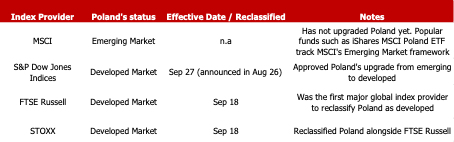
Source: Google search, East Value Research GmbH
Poland: The only ex-communist European country in the S&P Developed Markets index
In our view, the decision — which takes effect in September 2027 with the annual reconstitution of S&P’s indices — is a historic event that will alter the global perception of the Polish economy’s risk profile, potentially exerting a positive impact on the premiums investors demand for Polish bonds. As the first country in the CEE region to receive this upgrade, Poland will become the 27th developed market according to S&P Dow Jones Indices, joining the world’s leading economies such as the US, Germany, and Japan. S&P decided to reclassify Poland because it met key entry criteria, including a gross national income per capita above USD 15,000, an investment-grade sovereign debt rating, a sound monetary policy framework, and resilience to macroeconomic shocks.
Short-term and long-term consequences of the reclassification for Poland
In the medium to long run, we expect that the positive impact of the reclassification will be particularly visible in the Polish bond market, attracting increased interest from international mutual and pension funds that are exclusively mandated to invest in developed markets and consequently reducing debt costs for Polish issuers.
For equities, we see a risk that the consequences will be negative, at least in the short- and medium term. The first few months following next year’s implementation could bring pressure on Polish equities, as numerous emerging market funds are forced to liquidate their holdings. However, we believe this selling pressure will remain largely confined to certain stocks — particularly within the WIG20 and mWIG40 indexes — where international emerging market funds hold a significant stake. We expect that companies such as Allegro, Asseco Poland, and Synektik will remain relatively unaffected by Poland’s reclassification. This resilience stems from the fact that their international shareholder bases consist primarily of generalist funds and global institutional investors, rather than funds with an explicit emerging markets focus.
In the medium term, the potential capital pool available for the Warsaw Stock Exchange could actually decrease to c. USD 190bn from c. USD 250bn now, reducing the international demand for Polish equities. Although global asset management data (e.g., from McKinsey) shows that the vast majority of the c. USD 147tr in total global assets under management is allocated to developed markets rather than emerging markets (85–88% vs. 12–15%), Poland’s weight in the S&P Developed Markets index will be significantly smaller than its previous share (0.15% vs. 1.27%).
In addition, another critical aspect is the relatively poor quality of corporate governance and investor relations on the Warsaw Stock Exchange compared to Western developed markets. If Polish corporations hope to attract a new wave of international capital in the future, improving these standards will be essential.
In the long run, the international capital flows to Polish equities could however grow again with the growth of the total assets managed by the global asset management Industry. According to e.g. Boston Consulting Group, total AuM worldwide have grown at a CAGR of >9% over the last 50 years.
The domestic investor‘ market remains critical for the future of the Warsaw Stock Exchange
In our view, a very important factor for the further development of the Warsaw Stock Exchange remains its ability to attract more savings of Poles – which according to PFR in mid-June 2026 amounted to PLN 4.1tr, thereof PLN 1.95tr in cash, savings and other bank accounts – to the capital market. We see a chance that this will happen as the prospects for the Polish real estate market remain grim as already >86% of Poles (vs. 67% on average in the EU according to Eurostat) own a home and due to pessimistic forecasts for the development of Polish population in the next 25 years.
Forecasts for the Polish population 2025-2050 (in millions)
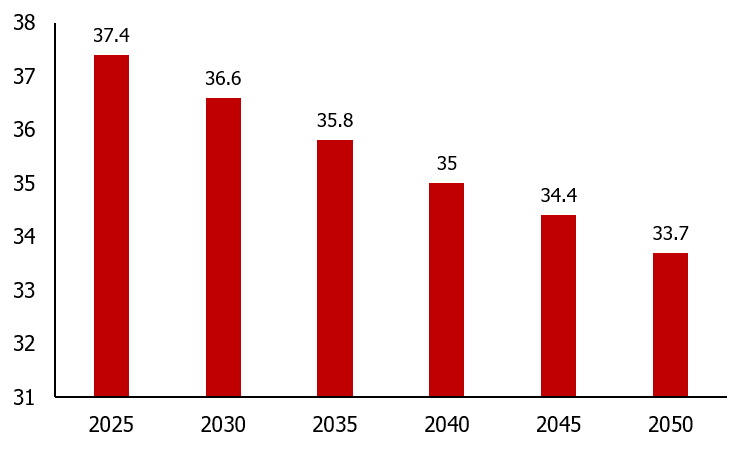
Source: GUS, Eurostat, Polish Ministry of Finance, East Value Research GmbH
In addition, a lot will depend on the further development of the new pension funds PPK – which since 2019 have already accumulated asset of PLN 58bn – as well as the new savings account OKI.
OKI, which will come into force in 2027, allows every Pole to save up to PLN 100,000 in stocks, passive & active funds or secure instruments e.g. deposits and government bonds (max. PLN 25,000 in them) with no need to pay the capital gains & dividend tax of 19% and the possibility to withdraw the money at any moment. In addition, every PLN of assets above this threshold will be taxed at 0.85%. According to the Polish government, this new savings account could generate additional capital flows for the Warsaw Stock Exchange of c. PLN 25bn by 2030E and c. PLN 74bn by 2040E. For comparison: In July 2026, the total turnover on the main market of the WSE amounted to PLN 58.1bn.
Author: Adrian Kowollik
