

A troubled history
The Balkan countries had a much more difficult post-communist transition than other CEE countries. The breakup of Yugoslavia and the ensuing Yugoslav wars completely destroyed the trade infrastructure, with foreign direct investments completely bypassing the region and flowing to other Eastern European countries instead. The history has caused an economic impact still felt today: the average real GDP per capita of the Balkans amounts to about 33% of the €39,680 EU average. Today, the Balkan comprises only 1.5% of the EU’s total trade in goods, although the EU is the main trade partner for most countries in the region, amounting to 60-70% of total trade exports. In certain parts of the Balkans, youth unemployment has historically hovered at about as high as 30-50%: a direct cause for mass migration. However, as we reason below, the Balkans still offers attractive investment opportunities in several of its economic sectors.
The EU as the North Star of Balkan economies
The region’s political and economic fate will be largely decided by the countries’ EU accession, with 6 of the Balkan countries, commonly referred to as the Western Balkans, not yet integrated into the EU. Bulgaria, Croatia, Greece and Slovenia are already part of the union. The stock indexes of the aforementioned countries have significantly outperformed major European indexes post-pandemic, e.g. compare the +59.9% growth of the Euro Stoxx 50 to the SOFIX (Bulgaria): +93.0%, CROBEX (Croatia): +110.0%, ATHEX Composite (Greece): 156.4%, and SBITOP (Slovenia): 194.3%.
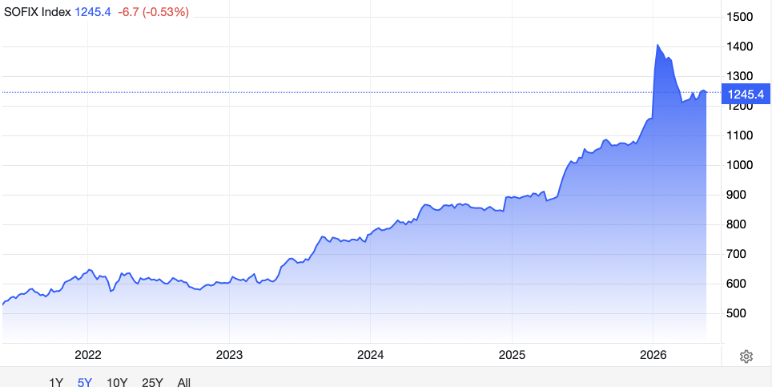
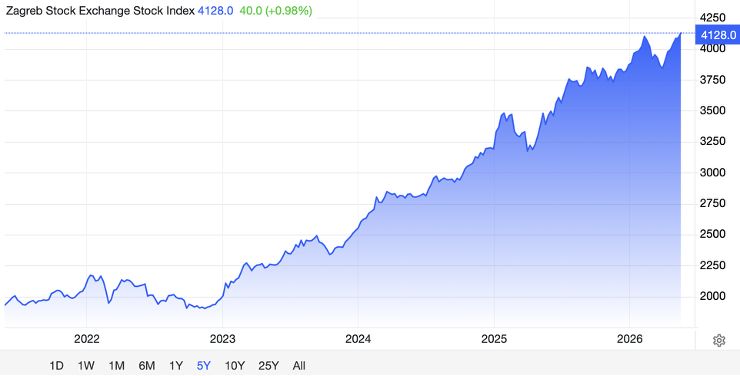
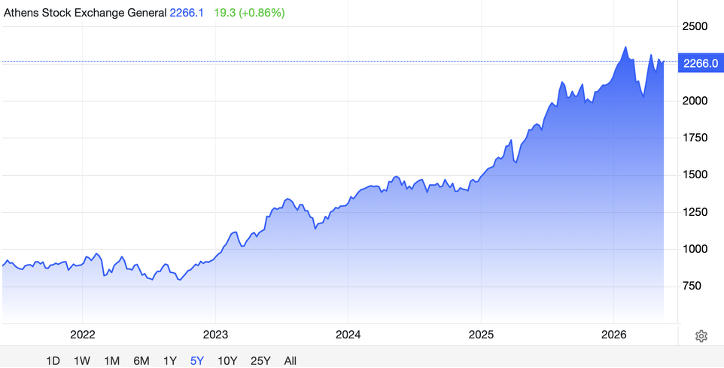
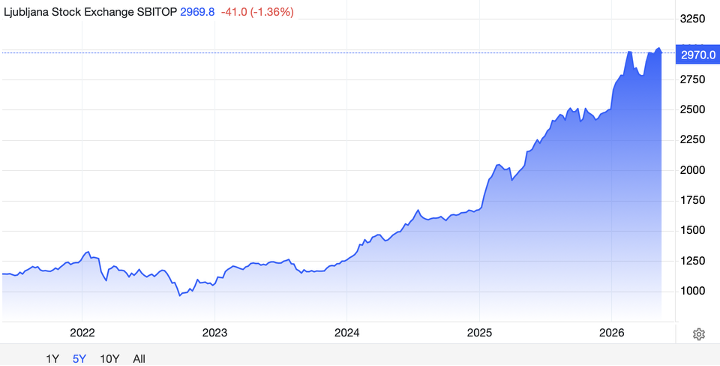
A significant contributor to this outperformance is continuing integration with the Eurozone, as well as European capital shifting into these countries. For instance, Croatia’s and Bulgaria’s Euro adoption removed FX risks and currency friction, while Greece saw pan-European institutional capital flow in due to its post-debt-crisis capital markets uprating by index providers. It is also noteworthy that the rally was heavily driven by the growth of single sectors, or even single companies, namely the financial sector (e.g. the Greek banking sector single-handedly pulling the index up due to the rerating of Greek bonds, or the appreciation of Slovenia’s NLB Bank stock heavily influencing the entire index), tourism (Croatia), or tech & pharma (Bulgaria).
Thus, the successful integration of the above countries in European markets provides a promising roadmap for the Western Balkan countries as well. The EU Growth Plan for the Western Balkans outlines a plan for doubling the size of the economies of the Western Balkans within the next decade, thus potentially creating attractive investment opportunities in the region. However, structural economic risks remain. One of these is brain drain, with 6% of the working-age population having flown out of the region since 2012 alone. Corruption is also a significant problem, with the average Corruption Perception Index of these countries being far below the European average (38 compared to 66). Infrastructure still lags behind the EU, as only 12-45% of the roads meet EU standards, while political tensions (e.g. Serbia-Kosovo or secessionist rhetoric in Bosnia) still plague the region.
Representing the region in one’s own portfolio
The main issue concerning investment into publicly traded companies from the Balkans is that the liquidity of these markets is low. Except Greece, which has an estimated average daily equity value of about €90M, the other countries have volumes in the low millions or even hundreds of thousands of euros. However, for a small institutional investor, it is still possible to capture the growth potential of some of the region’s sectors by incorporating small positions into their portfolio, trading London GDRs, or secondary listings of Balkan companies in markets like Bucharest, Warsaw and Frankfurt. Such investments might be very attractive, since they are undercovered by most major institutional investors, thus potentially less priced in.
Balkan blue-chip stocks do not only offer very attractive multiples (e.g. SBITOP ~14.3x and CROBEX ~11.5x average P/E ratios), but also very high and consistent dividends (often in the 6-9% range). In the financial sector, after a robust ~€500M profit after tax in 2025, we see the Slovenian NLB Bank as very promising, due to their ability to expand in the Western Balkans even in a low-rate environment. The post-crisis institutional capital inflow due to Greek credit rerating could also be an interesting investment thesis for Greek banks like Piraeus and NBG. There are significant anticipated tailwinds in the energy sector as well, as the Balkans is expected to absorb investments in alternative energy sources, often through EU funding, which could provide capital inflow for companies like the Croatian Koncar, the Greek Metlen, or the Bosnian Elektroprivreda BiH.
An overlooked, but promising sector, is also the healthcare sector, which can be a gold mine for Balkan growth stocks. In countries like Bulgaria and Croatia, there has been a +100% increase in healthcare spending in the last decade. As export operations ramp up, stocks like the Bulgarian Sopharma, Slovenian Krka, or North Macedonian Alkaloid Skopje, could turn out to be growth stocks despite being traditionally very defensive. Besides the tourism sector, represented by stocks like Valamar Riviera (proxy for Adriatic tourism growth, +10.6% Revenue YoY Growth), there are very exciting Balkan tech stocks as well, such as Sirma Group Holdings (enterprise software, +31..0% YoY revenue growth) or Shelly Group (a global smart-home and IoT leader, +40.3% YoY revenue growth), trading far below traditional multiples.
Finally, it is also possible to capture the Balkan’s growth potential through UCITS ETFs like Expat Croatia CROBEX or Expat Bulgaria SOFIX.
Author: Andrea Vaso
